
Spaldwick Primary School is a small, rural school situated on the outskirts of Huntingdon in Cambridgeshire.
There are currently 87 children on roll, split into four classes: Reception, Year 1/2, Year 3/4 and Year 5/6. With a predominantly White British demographic and just a handful of EAL children, most children travel to school by bus from local villages. Located within the commuter belt for Cambridge and London, Spaldwick is a school with a tangible family feel and a real sense of community, set within enviable grounds.
Our curriculum intent
At Spaldwick, we know our children well and do what we believe is right for them in every aspect of school life, including designing and implementing a curriculum that is best suited to their needs.
We want to provide our children with a curriculum that is highly relevant, challenging and engaging, developing resilience, independence and a love of learning. We offer a wide range of inspiring, practical and exploratory learning experiences, helping children to develop cultural capital through planned activities such as residential visits, museum trips and opportunities to learn about human creativity and achievement.
Our curriculum is diverse, holistic and purposeful. It recognises children’s strengths, such as curiosity and hard work, while providing opportunities to address areas for development. We are committed to an inclusive approach that ensures consistency, cohesion and progression for every learner.
Our school values of Pride, Independence, Enjoyment, Resilience and Care are reflected throughout our curriculum and wider school life.
At Spaldwick, every child is recognised as a unique individual. We celebrate and welcome the differences within our school community and believe that childhood should be a happy, investigative and enquiring time. The ability to learn is underpinned by the teaching of key skills, knowledge, concepts and values, while enhancement opportunities help to engage and inspire learners.
Our curriculum has been designed to:
- Recognise children’s prior learning
- Provide first-hand learning experiences
- Develop interpersonal skills
- Build resilience
- Nurture creativity and critical thinking
- Promote positive attitudes towards learning
- Encourage responsibility and independence
Children leave Spaldwick with a strong sense of belonging to a close-knit community, equipped with the confidence, skills and knowledge to make connections, reflect on their learning and become lifelong learners. We aim to raise aspirations and help pupils understand the impact they can have on the world, both within their local community and on a wider global scale.
Learning means the world
We use the Dimensions ‘Learning Means the World’ Curriculum as the vehicle for delivering an ambitious and engaging curriculum that provides full National Curriculum coverage.
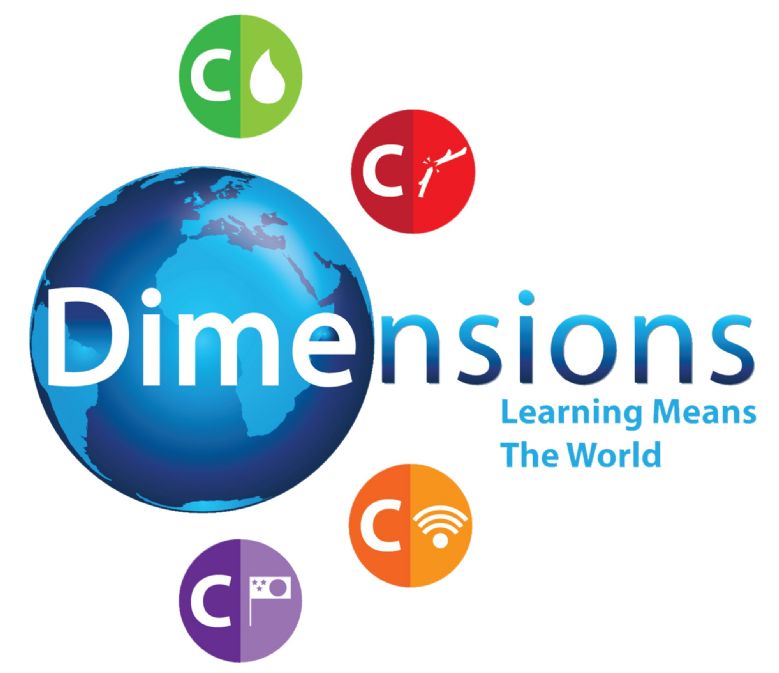
The curriculum is underpinned by four highly relevant global themes, known as the Four Cs:
We believe that language is the key to learning and provides children with the tools needed to fully access the wider curriculum.
We want our children to be confident communicators who can articulate their ideas clearly and value the opinions of others. Speech and language development is a priority from entry into school, and vocabulary development is a focus across all year groups. We are proud of our achievement in reading and our love of high-quality novels throughout the school.
Our curriculum provides opportunities for children to:
- Develop rich vocabulary and language skills
- Listen and respond with empathy and understanding
- Express thoughts, feelings and opinions confidently
- Collaborate effectively with others
- Present ideas clearly through discussion, debate and writing
- Adapt communication according to audience, purpose and context
As a school with a predominantly White British demographic, we want our pupils to appreciate, celebrate and embrace cultural diversity.
Through our curriculum, children develop an understanding of different cultures, faiths, traditions and heritages. They learn the importance of respect, tolerance and understanding, regardless of faith, gender, sexuality, ethnicity or background.
We actively promote cross-cultural friendship and understanding while encouraging children to value both local heritage and the wider diversity of modern Britain and the global community. Community involvement also plays an important role in our curriculum as children participate in local traditions, events and celebrations throughout the year.
We believe that learning to understand and manage conflict is an important life skill.
Our curriculum helps children develop empathy, appreciate different viewpoints and build positive relationships. Through learning about conflict in personal, community and global contexts, pupils develop the skills needed to:
- Understand the impact of their actions on others
- Respect differing opinions and perspectives
- Build positive relationships
- Resolve disagreements constructively
- Develop emotional awareness and self-regulation
- Understand the wider impact of conflict in the world
We want our children to care passionately about the world around them and understand how they can contribute to positive change.
As a school, we have already taken steps to become more environmentally sustainable, including investing in renewable energy and exploring opportunities to support local recycling initiatives. Through the curriculum, children develop awareness of conservation issues at local, national and global levels.
We encourage pupils to become informed, active citizens who can make a difference through problem-solving, collaboration and responsible action. Our aim is for children to understand that even small actions can contribute to a more sustainable future.
Curriculum organisation
At Spaldwick, our curriculum follows a thematic approach through the Dimensions: Learning Means the World framework. This enables children to make meaningful connections across subjects while ensuring full National Curriculum coverage.
Some subjects are taught through thematic units, while others are taught discretely to ensure depth, progression and subject-specific knowledge. Our timetable is carefully structured to provide a broad and balanced curriculum without narrowing children’s experiences.
Subjects taught through thematic learning
- Science
- History
- Geography
- Art
- Design and Technology
- Computing
- Music
Subjects taught discretely
- English
- Mathematics
- PSHE
- Religious Education
- Physical Education
- French
Each termly unit is driven by a key area of learning from Science, History or Geography and begins with a thought-provoking “hook” or catalyst question that sparks curiosity and engagement. Children are encouraged to investigate, explore and discover answers independently, developing resilience and confidence throughout the learning process.
Learning pathways
Within the Learning Means the World curriculum, children progress through four distinct learning pathways that reflect both their age and stage of development.
“Have a go!”
Children develop as:
- Experimental learners
- Curious thinkers
- Confident individuals
- Cooperative team members
“Find a way!”
Children become:
- Innovative
- Decisive
- Creative
- Independent

“Make it happen!”
Children grow into:
- Brave learners
- Risk-takers
- Resilient individuals
- Well-prepared thinkers
“Lead the way!”
Children develop as:
- Leaders
- Effective users of knowledge and skills
- Overcomers
- Focused and determined learners
This curriculum ensures that every child is challenged, inspired and prepared for the next stage of their education, while developing the knowledge, skills and values needed to thrive in an ever-changing world.
Theme roadmaps
Click on the links to the left of this page to see the road maps for each curriculum theme. These documents identify the key concepts taught across the four themes as the children move up through our school.
Subject areas
Please use the menu on the left to find out more about the different subject domains taught at Spaldwick. On each page you will find details about how and why we teach each subject, and important documents such as our subject overviews and skills ladders for each subject.